Saturday, November 15, 2014

Santa Cruz Friends

On Thursday, we went up into the Santa Cruz mountains to visit Bonny Doon Elementary. Darrow used to live in that area so it was great to be back home! The school buildings are mixed in amongst tall redwoods and we got to teach in the ideal redwood weather--fog! We worked with our friend Kate  Sommer, who is the LifeLab teacher at the school. LifeLab is an incredible organization that has put gardens in many of the schools in Santa Cruz county and the gardens provide great bird habitat. Students from various grades come to Kate throughout the day for science and garden education. In one day we got to work with every grade between kindergarten and 6th grade! It was great to work with such a wide range of students and experiment with our personal teaching methods. 
Listening in the garden
We began with the younger students and worked on listening, quiet observation, and learned how different habitats can have different birds. We got to watch the chickens in the garden for a bit. Who knew you could learn so much about birds just from watching domestic chickens?

What birds can you hear or see right now?
After lunch, we began working with the older students at the school. They knew a surprising amount about the birds on their campus already. In particular, the students knew all about the Acorn Woodpeckers that they have observed creating an acorn granary in some redwood trees near the school entrance. Good eyes! We were able to help them develop a sense for describing bird sounds and turn them on to ebird.org so they can contribute their observations to citizen science.
Our bird ID and diet lesson for the older students


Checking out the Acorn Woodpecker granary.

Checking out Stellar's Jays in the redwoods!
I hear a bird, but in which direction?


It's hard being a California Quail, hiding from potential predators.
We left Bonny Doon hoping our time spent with the classes will carry over to their studies of watersheds this Spring. Good birding!

Wednesday, November 12, 2014

This is How Beautiful a Thank You Can Be and The Bird School Project Reaches 500 Students!


Our time in Santa Cruz has been filled with visits with old friends and with some of our favorite birding spots. On Monday, we visited Main Street Elementary. A friend of a friend--Ilana Lowe--teaches 5th grade. She has her students keep nature journals and visit sit spots (nature observation spots) so these students were ready to learn more about birds on their schoolyard. We had a class of 25 students and got some wonderful close-up views of Black Phoebes, White-Crowned Sparrows, and Western Scrub-Jays. 

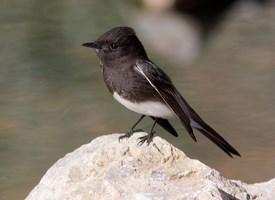
One helpful observation was that we had the chance to observe both the Black Phoebe and the Say's Phoebe.  We rarely get to see both of these birds during the same walk even though they are both common in coastal California. They are both in the genus Sayornis which means they are as closely related as one can get without being of the same species. Check out the differences and similarities below!


Black Phoebe Photo
Black Phoebe
Say
Say's Phoebe
Thank You Kevin!
We recently received some thank you notes from the Redwood Day School that we visited back in Oakland. We have received thank you notes from several schools now but we thought it would be good to show everyone how amazing these notes and drawings are. These students really spent some time on these and were are extremely grateful for their appreciation of our work. 
Thank You Darrow!


Thank you card from Redwood Day School kindergartners!
Today, we worked with two 3rd grade classes from The Gateway School. This school is down the street from where we used to live in Santa Cruz so we were working with a habitat we know well. The students got to meet the birds in the classroom and then we all went out to look for birds. We explored their LifeLab garden for wintering sparrows, blackbirds, starlings, and hummingbirds. We then continued to the adjacent Lighthouse Field Park where we got good looks at California Towhees and the beautiful bright, yellow Townsend's Warblers. Finally, we made it down the street to the ocean and got to have our first ocean birding session with students! We got to see pelicans, cormorants, gulls, terns, grebes, and surf scoters (a personal favorite...look it up!). The coast is amazingly rich with bird life!
Birding and taking notes on West Cliff

The Gateway School is in our old neighborhood!
Students at Main Street Elementary birding
the schoolyard

Learning birds in the best place--outside!

Kevin and his group identifying Golden-Crowned Sparrows


Check out the sparrow over there!

Finally, The Bird School Project officially reached its 500th student today! We are super thankful for all of the opportunities that led to this and we hope to work with another 500 before we finish in December! 

Monday, November 10, 2014

Big News and Bird Friends

After a very full and exciting week in the bay area, we have arrived in our hometown of Santa Cruz! On our way here, we made a stop to see our dear friend and fellow outdoor educator-- Devin "The El Camino" Peyton. He is working as a resident outdoor instructor for Vida Verde Nature Education. This is one of the coolest outdoor education centers we have seen. They provide three-day nature experiences for inner-city students in the bay area. And the best part is--they offer it all completely free of charge!!! Check out their website and support them if you can, we are 100% behind the work they do. http://www.vveducation.org 


We will be teaching here in Santa Cruz for the week before continuing south. Now that we have had the weekend to travel and organize our things, we think it is time to formally introduce our traveling companions--the birds.


Now, to the untrained eye, people may describe our bird specimens as "creepy," "gross" or "yucky." These are common words we hear from students when they meet the birds. But once kids get to know these birds, they regard them with love and wonder. We think it is important to give them some good spotlight and tell their story so you all might feel the same about them.


These birds are on loan from our teacher and mentor Chris Lay at the UCSC Museum of Natural History Collections. Chris is a major advocate for natural history education and in addition to inspiring us into this field, he has sparked the natural history flame in hundreds of students. He just received a two million dollar grant to create the Ken S. Norris Center for Natural History. Check out the article about it here.

We have four birds traveling with us. José the House Finch, Coop the Cooper's Hawk, Robin the American Robin, and Cedar the Cedar Waxwing. The birds spend most of their time in protective PVC tubes but when it comes time to work with students, they come out for guest appearances. The birds become instant friends of the kids'. The birds help students see the differences in body size, bill type, and colors. They might look "scary" at first, but give them a chance! They died years ago and provide so many opportunities for learning and inspiration in the students we work with.

We carry our friends in protective tubes!
Originally meant for bike travel, the tubes
still help to keep our friends safe

Here are our friends out of
their protective homes
Check out José's bill--meant for crushing
nuts and seeds
The House Finch
Our smallest yet most brightly colored bird.


Coop is a female Cooper's Hawk
Check out the bands on her tail!
She likes to eat smaller birds
Front view of Coop. She has huge talons
for grasping her prey. The males have an
orange-speckled breast

A close-up of Coop's meat-eating bill


Front view of Robin's orange breast
and black and white throat
Close-up of Robin's generalist bill.
She can eat berries, worms, and seeds!
Cedar's back
Check out the yellow band on the tail
the waxy flecks of red give it the name,
Cedar Waxwing


A close up of Cedar's black eye-mask and
the shorter generalist bill.
Cedar eats berries and insects
 
Finally, in other news, the Bird School Project was featured in the Huffington Post blog for our grant award from the pollination project! This is huge news for us! Please check out the article and if you have worked with us, leave a comment on the article about the work we are doing! Check out the article here.

Friday, November 7, 2014

Bird School meets Brightworks in San Francisco

This morning we spent quite a while at Glen Canyon Park in San Francisco with our new friends from San Francisco Brightworks. We explored the park's many habitats, from Eucalyptus groves, to dense thickets, and chaparral. Thanks to the watchful eyes of the Brightworks students, we found over twenty different species on our jaunt!


Our good friend, and Brightworks teacher, Mackenzie Price and her ever-curious crew.

One of the many aspects that makes Glen Park Canyon a unique environment for birds.

In our beginning circle, the students spotted a Red-tailed Hawk. We watched it swooping over the meadow and dive bombing (unsuccessfully) some sort of prey in the morning light. After this spectacular aerial display, Darrow spotted a bird flying high in the sky. A Peregrine Falcon! Wow, we were off to a good start. A few more minutes into the forest canopy and we saw a bright flash of yellow land in the tree in front of us.


It didn't take long for the students from Brightworks to discover this Townsend's Warbler in the field guide.

After staring into the canyon for a few minutes we had to spend some time with our field guides to make sure we had gathered everything we had just seen.  A Western-Scrub Jay, Yellow-rumped warbler, Common Ravens, and a Townsend's Warbler. And, we were hearing even more.


Teamwork. Its always helpful to go birding with a friend.

We kept moving up the canyon into the forest and took a break in the shade to talk about some of the main differences between birds.


Into the woods we go!


It doesn't take long to list the reasons for birds growing feathers. Or, does it?

Our discussion lead us to bigger questions like, "How did birds begin to grow feathers?" We sat in the trees, puzzling over the development of flight and wondering, "Why might feathers be helpful?" Piece by piece, we put together a pretty viable reason for birds to grow feathers and have other adapted traits for flight. 


Darrow shows off the talons and hooked bill of the Coopers Hawk while telling the story of Archaeopteryx.


A demonstration of the patience it sometimes takes to find small song birds high up in the canopy.


Our walk was perfectly concluded with another exciting aerial display between two Red-tailed hawks, swooping and shrieking across the midday sky. Huge thanks to San Francisco Brightworks for spending their day outside with us! Keep birding!

Species list: Red-tailed hawk, Common Raven, Peregrine Falcon, Northern Flicker, Bushtit, Ruby-crowned Kinglet, White-crowned Sparrow, Song Sparrow, Dark-eyed Junco, Gull sp., Steller's Jay, Western Scrub Jay, American Crow, Anna's Hummingbird, Black Phoebe, Townsend's Warbler, Lesser Goldfinch, Yellow-rumped Warbler, Hermit Thrush, Rock Dove, House Sparrow

Thursday, November 6, 2014

80 Students, 2 Counties, 15 Species--All In One Day!

We had a jam-packed day today filled with learning and fun. We began by visiting Redwood Day School in Oakland where we had the pleasure of working with thirty-five very bright 4th graders for two whole hours! We had enough time to really get into our activities and into our awareness out in the field. We even got to input our class data into the eBird database for use by the Cornell Lab of Ornithology! After the 4th graders, we got to work with two classes of Kindergartners and revisited our activity of becoming birds. We flapped our wings, hid in the garden, found good sources of food, and hid from patrolling Cooper's Hawks. We had a great time!
Looking at the Juncos while hiding behind the log
After our day at Redwood, we jumped in the car and headed straight over to San Francisco (We wouldn't have been able to do that on bikes!). And we made it just in time to Hillcrest Elementary where we met up with the after-school program that meets there. We had a group of fifteen students and were able to walk to the nearby Mclaren park for some sunset birdwatching. 
Kevin explaining about bird habitat

Getting a good look from the Red-Tailed Hawk
The whole class learning how to use binoculars
while looking at a very cooperative hawk
 The park was FILLED with birds! Now sometimes, it is difficult to get students excited about birding when there aren't many birds out. But when this Red-Tailed Hawk flew just above all of our heads as we were introducing ourselves and perched in the nearest tree, most of our work was done for us. These kids had never held binoculars before and their school mascot just happened to be the hawk. They were hooked!


As we continued our walk through the park, we got good looks at Robins, Juncos, Flickers, Crows, a Cooper's Hawk, and even the tiny Pygmy Nuthatches. We snuck up on Robins, tried to listen for worms in the ground (as Robins do), played with field guides, ran around in a rousing game of Jays and Chickadees, and searched the forested areas for owls. It was a magical 2 hours--the birdiest yet!
Hawk-watching
Working on binocular skills


Listening for worms 
This was a very full day but we had an amazing time with all and are feeling reinvigorated by the absolute beauty that comes with a habitat teeming with bird life and gentle birdsong.
Sneaking up on some American Robins

Field guides put a smile on my face too!
Walking where city meets park--obviously a safe haven for birds!


Tuesday, November 4, 2014

Franklin Preschoolers Take Flight

Today we had a busy day filled with our youngest group of students yet, and some fellow educators. 

We started by visiting the wonderful students of Franklin Preschool in Berkeley, CA and taught at three different classes. We asked them all the same thing. How do we know that a bird is a bird?

Is that soft stuff fur, or what?
Learning how to be gentle with Cooper the hawk.
Everybody gets one touch.


After some careful observation we started with our first clue as to what a bird is. They can fly!

Darrow and the kids aloft in the schoolyard.
So, we set off in flight from the nest to explore the playground and look for some birds. We were hoping that our observations would bring us closer to finding out what makes a bird a bird and not a lizard, or a butterfly? And, what did we find? An answer! A feather!

Scientists at work!
What do birds have and no other creatures have? Birds have feathers. So, we took the opportunity to unveil another treat from the Ken Norris Center for Natural History. A fully intact Cooper's Hawk wing. The students helped us count the feathers on this wing. 20 primary flight feathers!

Turns out practicing counting is fun if you count fun stuff.
Special thanks to all the teachers at Franklin, the brilliant students, and our good friend Shoshie, who teaches at Franklin, for organizing our visit.

In the evening we journeyed to Slide Ranch in the Marin headlands, a nature school for elementary schools in the San Francisco bay area. Darrow taught some of the staff about making fire with friction and we got to talk with them about how we lead our Bird School style walks with kids.

Slide Ranchers creating a coal with a bow drill kit.

Looking at birds through different lenses.

Watching a Black Phoebe at sunset on the Slide Ranch property.
Thanks to Justine Faust for bringing us to meet some inspiring naturalists in an inspiring place. A great and full day today and another two schools on the horizon for tomorrow!